Today is Remembrance Day 2026 
We've had a hell of a year
I'm writing this as a second affair has been revealed to the public. NVIDIA's Jensen Huang is inches from being ousted as CEO, if the reporting is to be believed. The man has run that company for 33 years.
The first affair, which he admitted to on the weekend, was with a woman US intelligence reportedly believes is a Chinese spy. The second, according to the Times, was with one of his own executives. The board is still in the room as I type this.
The markets are in a tumble, still reeling after the Blue Tsunami swept the USA. That pick another protein ad is a masterclass in political advertising. More on that in a minute.
To think we started this year with Maduro getting abducted and the release of the Epstein files...
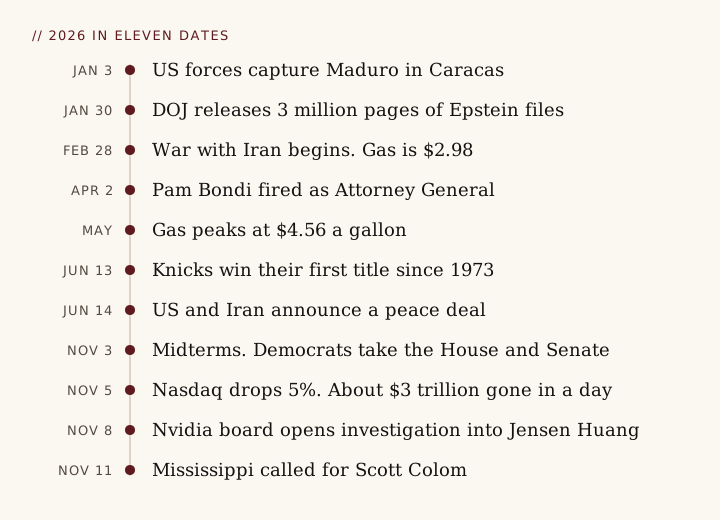
Let's recap
January 3. We woke up to the news that US forces had pulled Maduro out of Caracas in the middle of the night. Two days later he was pleading not guilty in a Manhattan courtroom.
By the end of the month the DOJ had dumped three million pages of Epstein files. Six weeks past the deadline, and with enough black ink to repaint the building. The fallout dragged into April, when Pam Bondi was eventually sacked, but not before losing her dignity.
Then came Iran. The war started on February 28. Gas was $2.98 that morning. A month later it was over $4, and by May it was $4.56. There was a ceasefire in April that lasted about a day, and a peace deal in June that has been wobbling ever since.
Fast forward 11 months and gas was $4.15 on Election Day, the most expensive Election Day fill-up on record. 2026 now holds the title for most days above $4. Affordability has been the mot du jour for many jours.
And so Mississippi, Texas, and Michigan are blue.
Read that again.
Texas elected James Talarico, its first Democratic senator since 1988. Michigan went blue top to bottom. And Mississippi, which only got called today, is sending Scott Colom to the Senate by about 4,700 votes.
About that ad
Back in February, Cindy Hyde-Smith was asked on TV about the price of beef. Her answer was that people have "so many proteins to choose from."
Eight months later, Colom's team cut an ad. Her quote, followed by regular Mississippians at the diner and the grocery store, all saying the same thing:
Pick another protein? I'd rather pick another senator instead.
That's the whole ad. Her words, one punchline, and the candidate delivering it last. Within a week Schumer's PAC had put $1.2 million behind him, in a state that hadn't sent a Democrat to the Senate since the 80s.
I sell for a living. You can spend a year building the perfect pitch, or you can let the other side say something dumb and hand it back to them. Colom won by half a point. Go watch it.
Meanwhile, in sports
The Knicks capped off a historic season with a championship, their first since 1973. Brunson took Finals MVP, Mamdani handed over the keys to the city, and both are now cemented in the history books (see also: the Brunson Egg and Cheese, available at a bodega near you).
World Cup 2026 was hosted in Toronto and I walked by many impromptu street parades. For a few weeks in June the whole city was outside.
The week the market broke
The day after the midterms, Wall Street threw a party. Best post-midterm rally in 44 years.
On November 5 the Nasdaq fell 5% and the Dow lost more than 1,800 points. Roughly $3 trillion gone by the closing bell, about $450 billion of it from NVIDIA alone. Yahoo called it the worst post-midterm day since 1896.
It wasn't the wave itself that spooked people. It was what rode in with it. A Democratic Congress, at least ten incoming governors promising to slow down data centers, and a pile of local votes I'll get to below. The entire AI trade is priced on the assumption that somebody keeps pouring concrete.
Then the Huang story broke over the weekend, and here we are. NVIDIA is down about 20% since it started.
I'm an economist by training, so I know better than to call a top. I'll just say that a market leaning this hard on one company, run by one man, was always going to have a bad week eventually.
In the Bay...
Remember the doom loop? Nobody in San Francisco does.
Tech used to mean glass towers in SoMa and the Financial District. The AI crowd wants nothing to do with them. The startups have been moving into smaller neighbourhoods instead. The Design District, Dogpatch, Potrero Hill. Places where you can walk to lunch.
Together AI is in the Design District. Scale AI and Gamma are a few blocks away. Y Combinator has been in Dogpatch since 2023. The cluster around Together is reportedly worth north of $40 billion, all within walking distance of each other. Their CEO's case for the neighbourhood is that the companies "will debug problems together or even think about partnerships."
That's the thing about this boom. It's tiny. SF AI startups raised $86 billion in a year, and a lot of it is sitting within a few blocks of itself. If you want to poach a researcher or bump into an investor, you don't go to Sand Hill Road anymore. You hang out within a half-mile radius of 16th and Kansas.
Everything is Agentic
2024 was chatbots. 2025 was copilots. 2026 is agents.
If you pitched an AI startup in 2023, your deck had a chat box in it. You typed a prompt, the model gave you a wall of text, and a human still had to copy and paste that text somewhere useful.
That looks ancient now. The pitch this year is software that does the job. It plans the work, opens the tools, runs the steps, and comes back when it's finished or stuck. Every demo day has the same word on every slide.
The tell is where the money went. By the summer YC batch, the bets had moved down a layer. Fewer startups building agents, more building the plumbing agents need to run in production. That's usually the sign that something has stopped being a trend and started being an industry.
I've built a few of these myself. A lead qualification agent, an account research pipeline, a voice agent that answers questions about my resume. Getting one to work in a demo is the easy part. Getting one you'd trust with a real pipeline is where the actual work is.
Compute Crunches
Of course, it wouldn't be a Silicon Valley boom without something to trip over.
The software is printing money. The buildings that run it just lost an election.
On November 3 there were 41 local ballot measures about data centers, across ten states. Voters picked the side that limits them in 40 of the 41. A blanket ban in Hubbard, Ohio passed with 76%. Granville went 82%. The Washington Post called it a nationwide backlash, and it wasn't a blue state thing. Red and blue towns alike looked at their power bills and said no thanks.
Notice it's the same story as the gas pump and the beef aisle. People will put up with a lot. They won't put up with the bill.
So founders in SF are waking up to a new reality. Compute isn't infinite, and Washington is watching closely.
What I'm watching in 2027
- Who is running NVIDIA by New Year's
- Whether the new Congress goes after data centers or just talks about it
- If the Iran deal holds, and what that does to gas
- Whether the agents start doing real work at real companies, or stay in the demo
- The Knicks. Obviously.
See you next November.